Why I Stopped Pretending I Had It All Together

Hello Beautiful Souls
You wanna know why I stopped pretending I had it all together?
Can I be honest with you for a second?
I got tired.
I got tired of "Hi, how are you?" "I'm fine, thanks, and you?" That exact exchange, on repeat, so automatic I could say it without even being in my body. I got tired of standing there listening to everyone's rehearsed stories about how great life was, half-listening, already rehearsing my own version in my head so I'd have something impressive enough to say back.
Because deep down, my reality wasn't "great." I was in the middle of an incredibly hard identity deconstruction — the kind where you're quietly taking apart who you thought you were and you don't yet know who's going to be left standing when it's done. But that's not exactly dinner table conversation, is it? So I smiled, said something upbeat, and kept the real thing to myself.
That's honestly why I stopped pretending. Not some mountaintop revelation, not a five-step plan I followed. I just got tired. Plain, bone-deep tired of performing like I had it more together than I did, while quietly going through something hard on the inside. And at some point, tired won.

What I Actually Mean by "Performing"
Okay, but let's back up, because I want to be careful with this word.
When I say "performing," I'm not saying we're all walking around lying to everyone. I don't think that's it at all, and honestly, most of us would never want to think of ourselves as fake. We're doing something quieter than that, and something way more automatic — we're playing a role.
Performing means becoming the version of yourself that's easiest to accept. More agreeable. More capable. More like you have it all figured out. It's not a conscious decision to deceive anyone — it's a survival skill so old and so practiced that most of us don't even clock it as a performance anymore. It just feels like who we are.
But it isn't who we are. It's who we learned to be so we'd be more likable, more approachable, less of a burden, less "too much." And the tragic part is that the more polished the performance gets, the further it takes you from yourself. You can spend years being so good at playing the role that you genuinely forget what's underneath it.
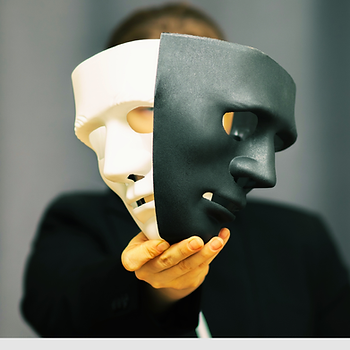
That's the mask. Not a lie — a role. One we've been rehearsing for so long it feels like our real face.
If I'm honest about why I did it, it wasn't really about hiding. It was fear — fear of being vulnerable, of letting someone see something less polished than what I usually showed. And it was also about them, in a strange way. I didn't want to make anyone else uncomfortable. Small talk is easy, and honestly, most of the time I like it — it's not that the exchange itself is the problem. It's that somewhere along the way, "how are you" quietly turned into an invitation to perform, and I got so used to answering the performance instead of the question.

What Wearing It Actually Costs You
And here's the thing nobody tells you about performing "having it together": it is exhausting in a way that never shows up on paper.
You can't point to it. There's no single event, no obvious wound. Just a slow, steady drain — the energy it takes to monitor how you're coming across, to keep the tone upbeat, to make sure you seem more together than you actually are, to smile through the moments you actually needed someone to ask how you were and mean it.
Performing takes energy that should be going toward actually living. Toward resting. Toward feeling your own feelings instead of managing everyone else's experience of you. When most of your energy goes into how you appear, there's almost nothing left for who you actually are.
Taking the Mask Off
I wish I could tell you there was one dramatic moment where I ripped the mask off. There wasn't. It was slow, and honestly, at first I didn't even know it was happening.
Looking back, I think it started with my appearance. I'd shaved my hair — but I was afraid to actually go out into the world with it shaved, so I wore a wig. For a while, that felt like the safest option. And then one day, I just... left the wig at home. No plan, no big speech to myself about it. I just didn't put it on.
From there, it moved into how I dressed. I stopped performing to beauty standards the way I had been — stopped reaching for what felt "acceptable" or expected and started choosing what actually felt comfortable.
And then, slowly, it moved past appearance entirely. I stopped saying I was fine.
That didn't mean I suddenly told everyone my business. I still kept plenty to myself — I didn't owe anyone the details. But I stopped performing fine when I wasn't. I let myself just be present. Be there. Be surviving, some days, instead of pretending I was thriving.
Somewhere in the middle of all these small choices, something clicked internally — it was like my mind and my body were finally on the same page for the first time in years. I wasn't performing a decision to "be myself." My outside was just starting to catch up to what was already true on the inside.
That's what surprised me most: taking the mask off didn't happen through some big internal breakthrough first. It happened through small, outward choices — and the inside caught up.
And it didn't make things fall apart, like I feared it might. It made things lighter.
The energy I'd spent monitoring, managing, performing — it slowly came back to me. I had more of myself to actually live with. And in that space, I started noticing something I hadn't let myself believe before: being myself was okay. Not impressive, not polished, not curated — just okay. Enough, even. That was new.
It's a strange kind of freedom, being allowed to not perform. Being allowed to leave the wig at home, skip the show, say "I'm surviving today" instead of reaching for something more impressive. Being allowed to take up space as the actual, unedited version of you.
If You're Tired Too
If you recognized yourself in any of this — if you're performing "great" so well that you've started to forget what's actually true underneath it — I want you to know you're not broken, and you're not alone in this. This exhaustion has a name, and more importantly, it has a way out.
This is the exact place I started when I began the work that became my book, SHIFT: From Survival to Self-Trust. Taking the mask off isn't the whole journey — but it's where every real shift begins.
If this resonated with you, stay tuned for the next post, where I go deeper into what it actually takes to heal what the performance was covering up.


Comments